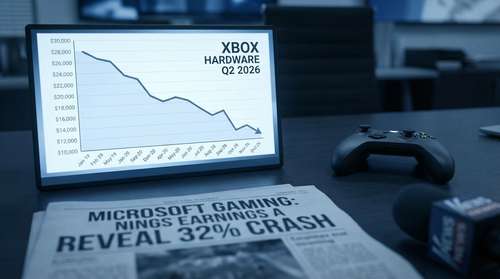
The long-feared Xbox hardware death spiral has moved from industry speculation to statistical reality. Following Microsoft's Q2 FY26 earnings report released on January 29, the gaming giant revealed a staggering 32% year-over-year decline in hardware revenue. This latest financial disclosure has reignited the viral debate surrounding the brand's viability as a console manufacturer, fueling narratives that Microsoft is accelerating its pivot to a purely software-driven, multiplatform publisher. With console sales in freefall and flagship titles migrating to rival platforms, the traditional Xbox ecosystem faces its most critical existential challenge to date.
The Numbers Don't Lie: Inside the Fiscal Crash
The term "death spiral" refers to a self-reinforcing cycle: a shrinking install base leads to lower software sales, which discourages developer support, further reducing the incentive for gamers to buy the console. The latest Microsoft gaming news confirms this cycle is spinning faster than anticipated. For the quarter ending December 31, 2025, total Xbox gaming revenue fell by 9%, driven heavily by the steep 32% drop in hardware sales.
This marks the second consecutive quarter of massive declines, following a 29% drop in Q1. While Microsoft CFO Amy Hood had forecasted a decline, the severity of the drop suggests that the Xbox Series X|S generation has stalled completely in key markets. Unlike the supply-constrained early years, this dip indicates a demand problem. With the install base stagnating, the "attach rate"—the number of games sold per console—becomes harder to sustain, pressuring Microsoft to look elsewhere for growth.
Xbox Multiplatform Strategy 2026: The PlayStation Migration
As hardware adoption slows, the Xbox multiplatform strategy 2026 has shifted from an experiment to a necessity. In the wake of the earnings report, industry insiders have doubled down on reports that formerly sacred exclusives are bound for PlayStation 5. While games like Sea of Thieves led the charge last year, fresh leaks suggest that heavy hitters like Starfield and the upcoming Forza Horizon 6 are being evaluated for cross-platform release windows.
Xbox Game Studios head Craig Duncan recently addressed these concerns, stating, "We want our games to reach the most players that we can." While he emphasized that some titles will remain "timed exclusives," the ambiguity has done little to quell the anxiety of loyalists. If Xbox exclusives on PS5 become the standard rather than the exception, the unique selling proposition of owning an Xbox console evaporates, further accelerating the hardware decline.
The Third-Party Publisher Paradox
Critics argue that Microsoft is effectively becoming a third-party publisher with a legacy hardware business attached. By putting its biggest IP on competitor hardware to offset the Xbox console sales 2026 slump, Microsoft gains immediate revenue but cannibalizes the long-term future of its own ecosystem. It is a calculated risk: sacrificing the "console war" to win the "content war."
Future of Xbox Consoles: Is There a Next Gen?
Despite the grim figures, Microsoft leadership insists they remain committed to hardware. CEO Satya Nadella reaffirmed this week that the company is "committed to delivering great games across Xbox, PC, cloud, and every other device." However, the phrase "every other device" is doing the heavy lifting. The future of Xbox consoles may look drastically different, potentially morphing into niche, high-end PC-like hybrids or dedicated cloud streaming sticks rather than mass-market boxes designed to compete directly with Sony.
Rumors of an Xbox handheld continue to swirl as a potential savior for the hardware division, but without a massive install base turnaround, traditional home consoles seem to be deprioritized. The industry is watching closely to see if the "next-generation" Xbox promised by Phil Spencer will actually materialize as a traditional competitor, or if the brand will fully transition to a service (Game Pass) that lives on everyone else's hardware.
Market Trends and the 'Screens' Era
The gaming industry market trends in 2026 point toward a screen-agnostic future, and Microsoft is leading that charge—willingly or not. The decline in Content & Services revenue (-5%) was also notable in the Q2 report, signaling that even Game Pass growth has struggled to offset the loss of hardware momentum. This creates a dangerous precariousness: if hardware dies, Game Pass must grow exponentially on PC, Mobile, and PlayStation to compensate.
For gamers, the writing appears to be on the wall. The era of the "console warrior" is ending, replaced by a landscape where the Xbox logo is a startup screen on a PlayStation 5 or a mobile app, rather than a plastic box under the TV. Whether this is a brilliant evolution or a "death spiral" failure depends on whether Microsoft can survive the transition without losing its core identity.