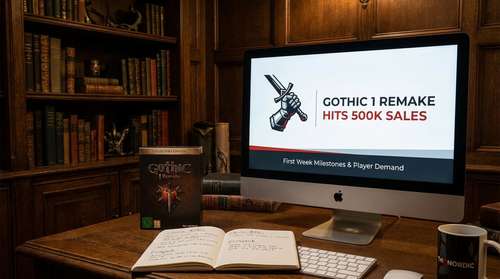
When a 25-year-old, notoriously punishing European role-playing game gets a modern overhaul, conventional wisdom suggests it will appeal strictly to a niche audience. But the market has just proven the analysts wrong. Exactly one week after its highly anticipated June 5 release, the staggering Gothic 1 Remake sales figures have sent shockwaves through the industry. Moving over 500,000 copies across PC, PlayStation 5, and Xbox Series X|S, the return to the Valley of Mines is a certified commercial triumph. In an era dominated by sanitized, predictable gameplay loops, players are hungry for titles that refuse to hold their hands, and this unapologetic revival delivers exactly the friction they crave.
Steam Dominance and Unprecedented Player Engagement
The initial momentum was visible immediately upon launch. Tracking the Gothic 1 Remake Steam player count, the title surged to a massive peak of nearly 78,000 concurrent players by June 7. For a single-player, narrative-driven experience devoid of live-service hooks, these metrics are exceptional, easily placing it among the top trending titles on the platform.
What makes these numbers particularly fascinating is the wide divide between critical consensus and player reception. While the mainstream Gothic 1 Remake review scores hovered around a respectable but modest 73 on Metacritic—with some critics docking points for early performance hiccups and archaic design philosophies—the gaming community vehemently disagrees. On Steam, the title boasts an 85 percent "Very Positive" rating across more than 15,000 user reviews. Fans who spent years waiting for a faithful restoration are getting exactly what they paid for: a treacherous, uncompromising world that demands genuine effort from anyone brave enough to step foot inside.
Preserving the Soul of a Gothic Remake Eurojank RPG
At the core of this breakout success is developer Alkimia Interactive's firm commitment to keeping the game's original spirit completely intact. Rather than sanding down the rough edges to appease modern sensibilities, the Barcelona-based studio doubled down on the elements that made the 2001 classic a cult legend.
This is the quintessential Gothic Remake eurojank RPG experience, modernized just enough to be accessible but entirely willing to let you fail. The game notoriously strips away the comforts players have grown accustomed to over the last two decades. You are thrown into the penal colony with no backstory, no special powers, and nothing but the clothes on your back.
- No Free Navigation: There is no magical minimap guiding you to your next objective. If you want a map, you have to buy a crude, expensive one in-game.
- Lethal Environments: Wander too far from the safety of the Old Camp, and a pack of wolves will tear you apart in seconds.
- Reactive NPCs: The inhabitants of the colony operate on their own schedules. If you try to pickpocket them or break into their huts while they sleep, they will wake up, alert the guards, and beat you unconscious.
This level of friction is exactly why the game is resonating so strongly. The triumph of the THQ Nordic Gothic Remake partnership proves that gamers are exhausted by theme-park open worlds and desperately want organic, dangerous environments that react to their bad decisions.
Pushing Boundaries Among Unreal Engine 5 RPGs
Rebuilding the expansive, interconnected Valley of Mines required serious technical heavy lifting. Powered by the latest rendering technology, the game stands out among recent Unreal Engine 5 RPGs for its atmospheric density. The original release was forced to split its world into chunks separated by loading screens; the remake entirely eliminates these barriers, presenting a seamless, cohesive valley that radically enhances immersion.
This visual leap did not come without some turbulence. Launch day brought a share of technical hurdles, particularly concerning optimization on the PlayStation 5 and isolated crashes on PC. Thankfully, Alkimia Interactive moved swiftly, deploying Patch 1.0.1 within days to address frame generation bugs, DLSS implementations, and even adjusting the highly debated lockpicking difficulty. The aggressive post-launch support has maintained player goodwill and kept the momentum strong.
Securing the Future of the Franchise
Surpassing half a million units sold in a mere seven days is a decisive victory. In a joint statement, both the publisher and development team expressed profound gratitude to the passionate community that kept the IP alive for a quarter of a century, confirming that continued support is mapped out for the coming months.
For the loyalists who backed this project from the controversial playable teaser years ago, these sales figures represent something far more important than just corporate revenue. They represent validation. By proving that a hardcore, friction-heavy role-playing game can secure a massive audience in 2026, the success of the Gothic 1 Remake all but guarantees that this won't be our last trip to the colony. If this trajectory holds, a return to Khorinis in a full Gothic 2 remake seems not just possible, but inevitable.