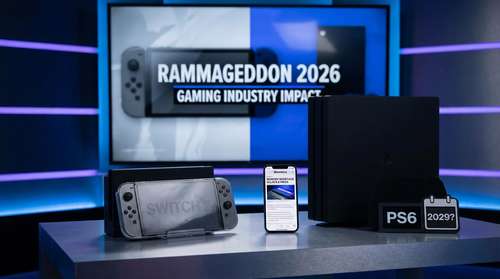
The era of affordable next-gen gaming may be coming to an abrupt end. A bombshell report from Bloomberg has sent shockwaves through the industry, confirming that Nintendo is actively weighing a price increase for the Nintendo Switch 2 less than a year after its debut. Simultaneously, Sony has reportedly pushed its internal release window for the PlayStation 6 to 2028 or even 2029. The culprit? A global memory chip shortage dubbed 'RAMmageddon,' driven by an insatiable hunger for AI hardware that is cannibalizing the supply chain for consumer electronics.
The 'RAMmageddon' Crisis: How AI Broke the Supply Chain
To understand why your gaming hobby is about to get more expensive, you have to look at the data centers powering the artificial intelligence revolution. The global explosion in demand for generative AI has created a desperate scramble for high-performance memory. Tech giants like OpenAI, Google, and Meta are purchasing Nvidia accelerators in massive quantities, and each of these units requires vast amounts of DRAM (Dynamic Random Access Memory).
This 'AI gold rush' has fundamentally broken the supply-and-demand balance. According to Bloomberg's reporting, the cost of specific DRAM modules surged by over 75% in just the last month. Manufacturers like Samsung and SK Hynix are pivoting their production lines to prioritize high-margin AI memory, leaving traditional consumer electronics companies fighting over scraps. For gamers, this is RAMmageddon 2026: a scenario where console makers can no longer subsidize hardware costs because the components themselves have become luxury goods.
Nintendo Switch 2 Price Hike: A Post-Launch Shock
Perhaps the most immediate sting comes for Nintendo fans. The Switch 2, which launched in June 2025 at a competitive $449.99, has already sold over 17 million units. However, the cost to manufacture the device is climbing rapidly. Reports indicate that the price of the 12GB RAM modules used in the console has jumped approximately 41% this quarter alone.
While Nintendo President Shuntaro Furukawa recently told shareholders there were no "immediate" plans to change pricing, the tone has shifted. The Bloomberg report suggests executives are now seriously contemplating a mid-cycle price hike to protect profit margins—a rare move in the console business, where hardware usually gets cheaper over time. If you have been waiting for a discount to pick up the new handheld, you might have missed your window. The window for affordable Nintendo hardware pricing is closing fast as the company grapples with component costs that simply didn't exist when the system was designed.
What This Means for Buyers
If Nintendo pulls the trigger, we could see the standard model jump to $499 or higher in the US market. This potential increase places the Switch 2 in a precarious position, edging closer to the pricing territory of more powerful home consoles just as its component costs spiral out of control.
Sony PlayStation 6 Delayed to 2029?
While Nintendo fights to keep current shelves stocked, Sony is rethinking its future. The PS6 release date delay is shaping up to be the other major casualty of this memory shortage. Originally targeting a 2027 launch to replace the PlayStation 5, Sony is now reportedly looking at 2028 or 2029 for its next generation.
The logic is brutal but sound. A next-gen machine would require massive amounts of ultra-fast GDDR7 memory to deliver a true graphical leap. Launching in the middle of an AI-driven memory shortage would force Sony to either price the PS6 at an astronomical $1,000+ or swallow billions in losses. By pushing the release back, Sony is effectively betting that the AI memory shortage will stabilize over the next three years.
This delay extends the lifecycle of the PS5 significantly, pressuring developers to squeeze every ounce of performance out of current hardware for nearly a decade. It also leaves a massive opening in the market, though it remains to be seen if Microsoft will capitalize on it or face similar delays with the next Xbox.
The Broader Impact on Gaming Hardware
The Bloomberg gaming news report makes one thing clear: this isn't just a console problem. The Sony PlayStation 6 news is just the tip of the iceberg. PC gamers are already seeing SSD and DDR5 RAM prices creep upward. The "tax" imposed by the AI industry's demand for silicon is being passed down to every consumer device that uses memory.
We are entering a period where hardware stagnation might become the norm. If costs remain elevated, the rapid iteration cycles we are used to—new pro consoles, annual phone upgrades, cheaper storage—will disappear. The industry is in a holding pattern, waiting for memory manufacturers to build enough capacity to satisfy both the AI robots and the human gamers.
For now, if you see a console at MSRP, grab it. In the economy of 2026, holding onto cash might be the riskiest move of all.